
Finding Bryan Residents Through Records
There is no one government list of every person in Bryan. A property record can identify a person connected with a parcel, while an election record can answer a registration question and a deed can show a party to a transfer. A library directory may place a household at an address in a particular year. These are different facts. Start with the record that fits the question, preserve the date shown, and avoid treating an owner, a voter, a court party, and an occupant as interchangeable roles.
For a current address, the property and map route is often the clearest first check. For a past household, a dated directory and deed trail can work better. A name-only search needs an added anchor such as a parcel ID, instrument number, case number, VUID, dated civic appointment, or exact cemetery plot before two records should be joined.
- Search the address or owner name in the Brazos Central Appraisal District property search and save the property or geographic ID.
- Compare the mapped address with the City of Bryan GIS layers, especially when city limits, ZIPs, or historic districts matter.
- Use the Brazos County Clerk land index for deeds, deeds of trust, releases, plats, and other recorded instruments.
- Use the official voter verification route only for a registration question, keeping protected fields and ballot choices out of the search trail.
- For older residents, request or inspect the Carnegie, Texas A&M, and Texas State Library materials that cover the time period.
Bryan Parcel Names and Addresses
The Brazos Central Appraisal District Property Search is the local starting point for current appraisal context. Its public screen exposes Owner Name, Street Number, Street Name, Property ID, Geographic ID, subdivision, neighborhood, tax year, property type, abstract, and other advanced fields. When the address parser is stubborn, BCAD advises leaving prefixes, suffixes, and unit numbers out of the Street Name field. Save the returned identifiers with the source date.
A BCAD result is not a residency certificate or title opinion. Appraisal information helps tie a current parcel to an owner display and legal-description clues. The district says legal descriptions and acreage should be checked with the County Clerk. A mailing address can be a correspondence or tax-bill address, while a situs address identifies the mapped property.
BCAD's public search screen shows the range of owner, address, ID, and advanced filters available for a Bryan residents directory search.
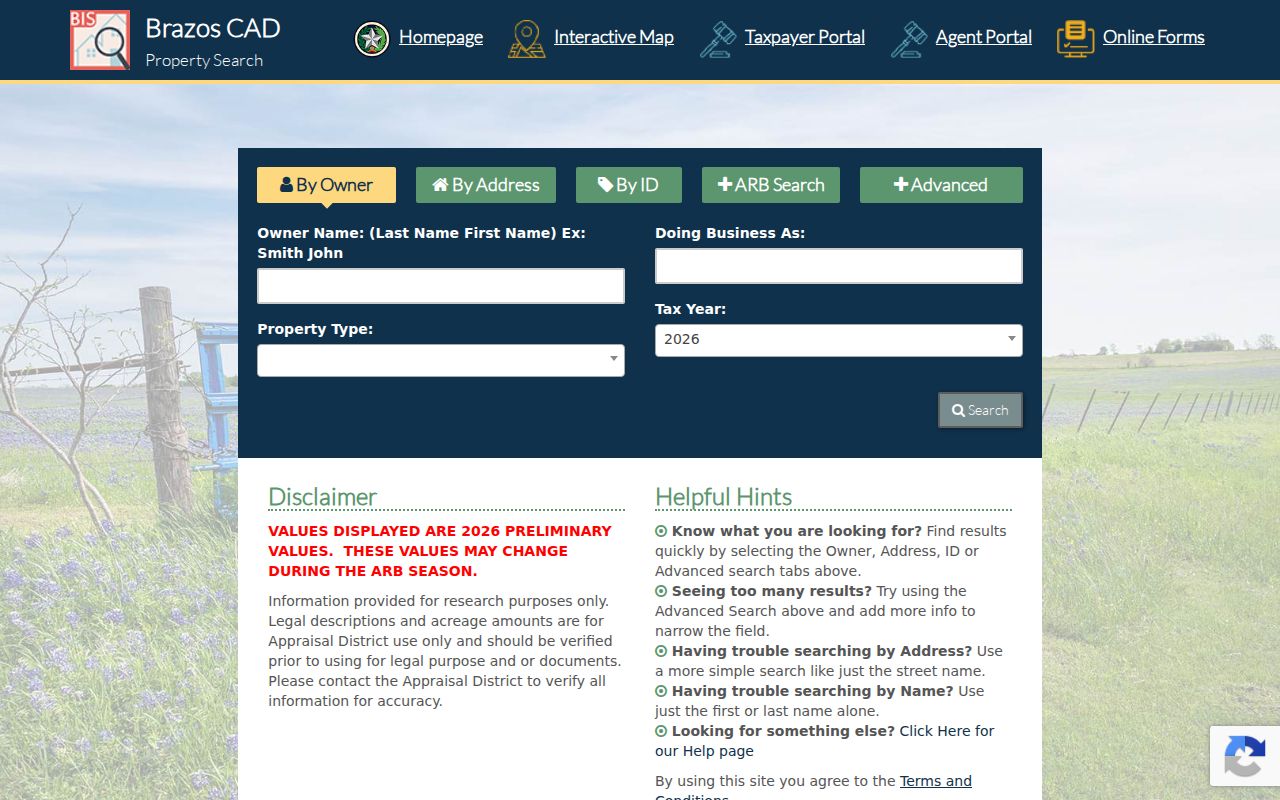
Those fields make a parcel identifier more useful than a name alone when a later deed or map must be checked.
| BCAD field | Practical use |
|---|---|
| Owner Name | Property-tax context, not proof of present occupancy. |
| Street Number and Street Name | Address entry point for a parcel search. |
| Property ID or Geographic ID | Stable clue to carry into a map or record request. |
| Subdivision, neighborhood, abstract | Clues for legal-description and map comparisons. |
Bryan Offices Behind Resident Records
Resident research in Bryan moves between county, city, and state custodians. The Brazos County Clerk holds real estate, marriages, probate, civil filings, birth and death certificates, brands, and DD214 discharges. BCAD maintains appraisal context. Brazos County Elections handles registration and roster routes, while the Bryan City Secretary is the city records-management and vital-statistics hub. The District Clerk and Bryan Municipal Court are separate court paths. Knowing the keeper prevents an otherwise good request from going to the wrong office.
Brazos County Clerk
Land records, probate, marriages, and county-held certificates
County Clerk records and office information
Brazos Central Appraisal District
Current appraisal and parcel context
BCAD Property Search
Brazos County Elections
Registration verification and election-roster routing
Brazos voter registration verification
The County Clerk page is the official entry point for the Bryan land-record and county-record trail.
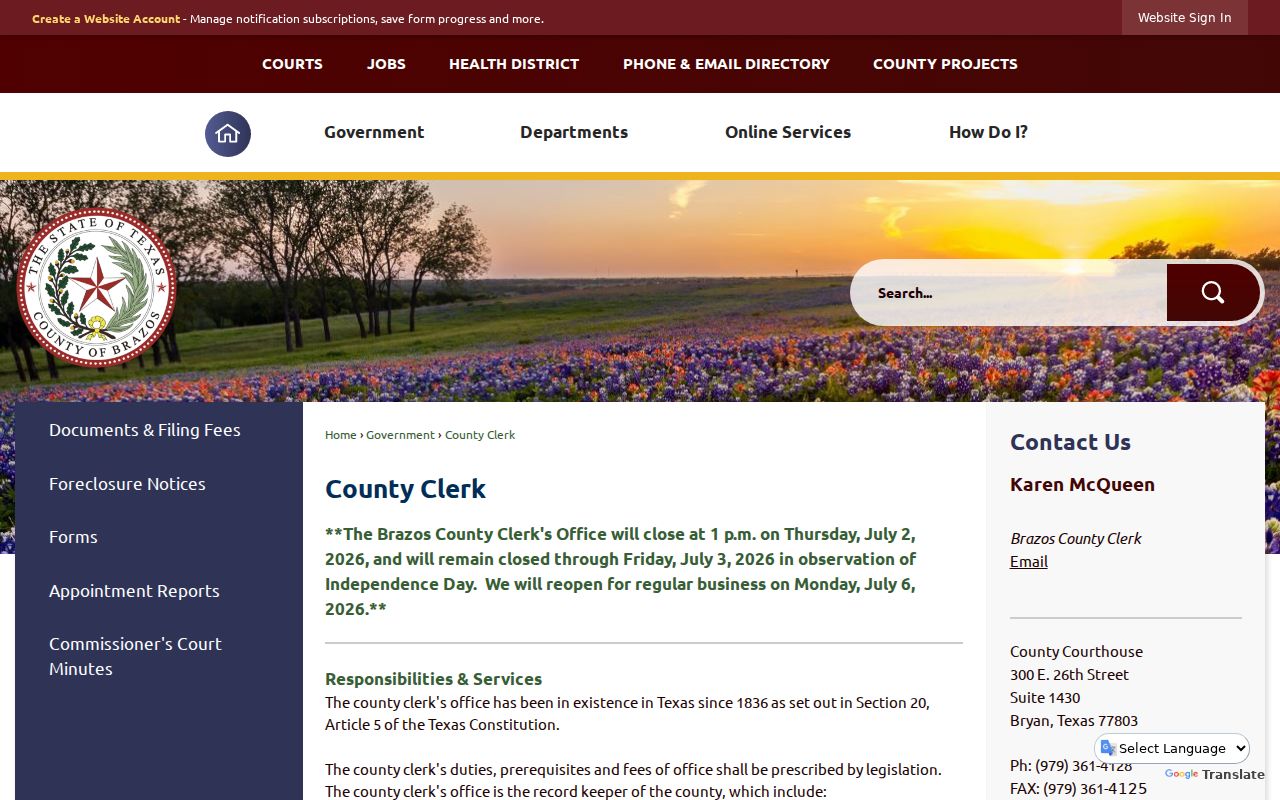
The office split matters because a city record, appraisal entry, court file, and deed are not held by one searchable system.
Bryan Deed Indexes Since 1841
Brazos County deed records begin in 1841. The official land-record search provides Quick Search and Advanced Search, a search term, recorded-date range, quick date ranges, and options for index-only or index-and-full-text searching. A multiword index search and an OCR full-text search answer different questions. Search grantor and grantee roles separately, then retain the instrument number, recording date, document type, legal description, and image or book reference the system provides.
Land records are powerful Bryan resident leads, but the names can be a trustee, estate, lender, spouse, or attorney instead of someone who lived at the structure. Filing can also trail the transaction. A deed chain needs probate, divorce, partition, heirship, and court checks when a conventional sale does not explain a transfer. For an address-first workflow, use the Bryan street directory rather than treating a name search as a block search.
Brazos County Open Records provides the defined county-request route when a deed or other record needs a counter or custodian follow-up.
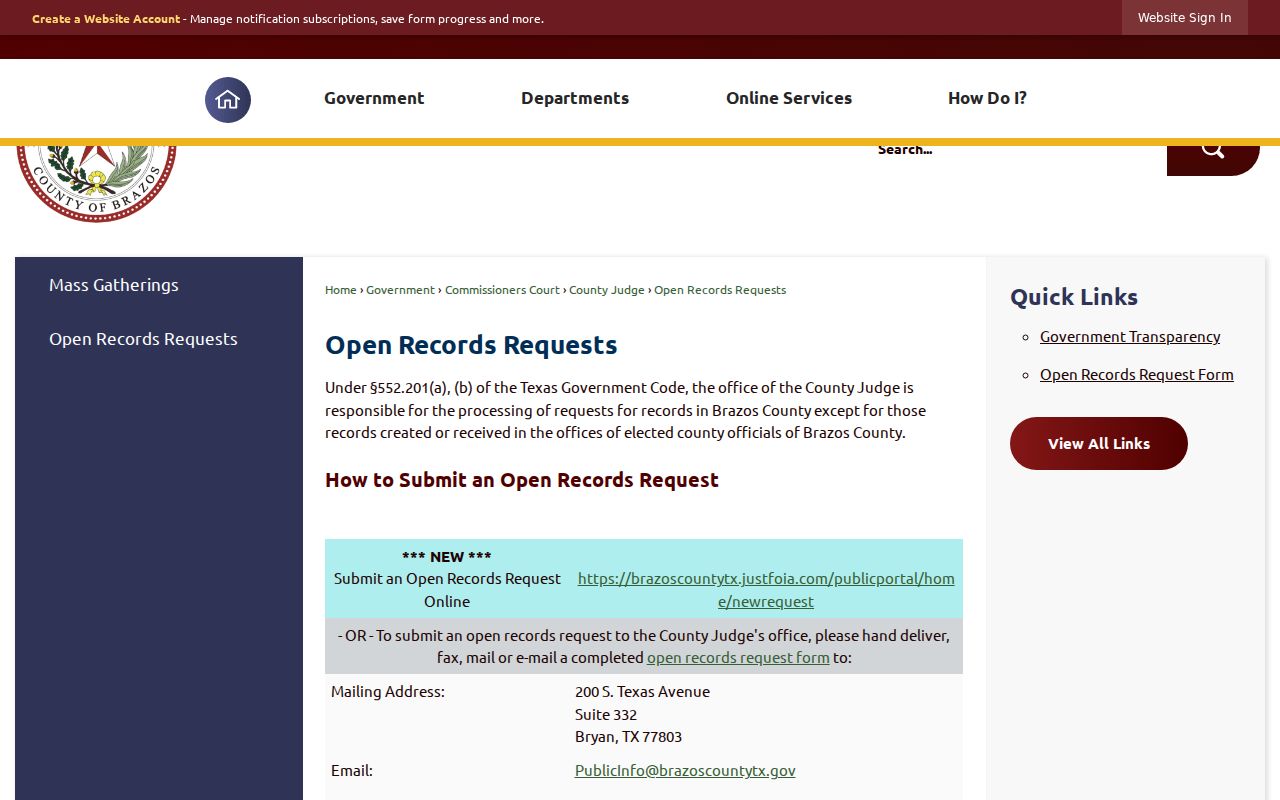
When an online result is incomplete, a narrow county request or counter inquiry can be more productive than a broad name-only search.
- Parcel
- A mapped property unit used for appraisal and GIS work. It is not a complete title history.
- Index
- A finding tool that points to a record. It may not include every image, attachment, or protected field.
- Grantor and grantee
- The parties named in a conveyance, usually the person or entity transferring and receiving an interest.
- Legal description
- The lot, block, addition, survey, or metes-and-bounds language used to identify land beyond a street address.
Bryan Voter Verification Limits
Brazos County directs registration questions through VoteTexas and the county's registration route. The verification process can use a Texas driver license number if supplied, a VUID, or a first and last name. Election-roster files are a separate product with election, party, and participation categories. A participation field does not reveal a ballot choice, and a county registration result does not establish that a person is inside Bryan city limits.
Texas Election Code and Secretary of State guidance protect driver-license, personal ID, Social Security, phone, and certain voter-address information. ACP participants and other protected voters may use a substitute or suppressed address. An asterisked, blank, or substitute address can be a privacy safeguard, not a bad data point. Keep voter research limited to the lawful public output and record the access date.
Brazos County's registration page links the official verification route used for this Bryan residents directory research.
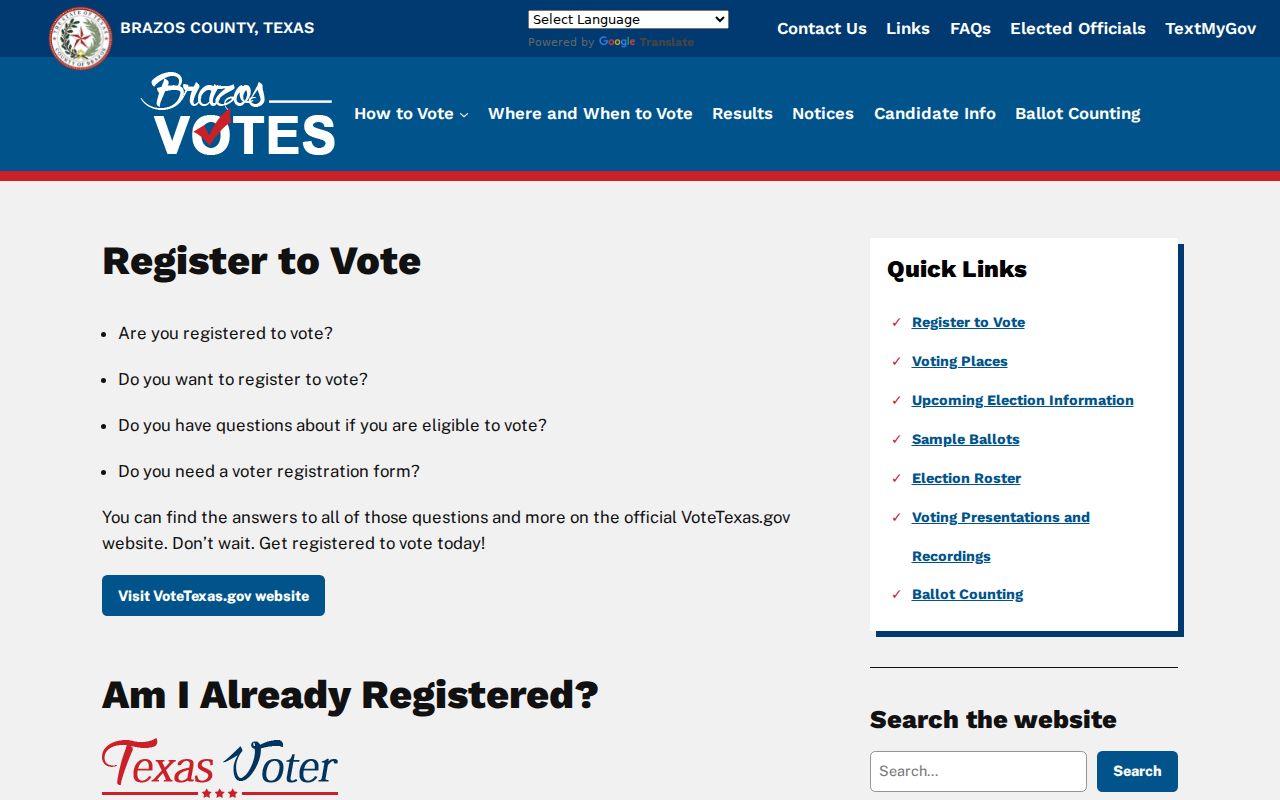
The route is useful for a defined registration question, while a parcel, deed, or directory answers a different resident question.
Current Bryan Resident Directory Sources
Current directory-like sources each cover a narrow population. BCAD identifies people tied to an appraisal account or parcel. The County Clerk index identifies parties to recorded instruments. Election verification answers a registration question subject to privacy limits. Bryan OnBoard gives public board and commission membership, vacancies, and member history. None of those sources proves that every person at an address is listed, and each must be read with its own date and role.
| Record path | Resident connection | Custodian | Access route |
|---|---|---|---|
| BCAD property search | Owner and parcel appraisal context | Brazos Central Appraisal District | Public search screen |
| Land-record index | Grantor, grantee, estate, trustee, or other instrument party | Brazos County Clerk | Online index, counter, and historic microfilm |
| Voter verification | Defined registration question | Brazos County Elections / VoteTexas | Official verification route with protected fields excluded |
| City OnBoard | Board and commission role or term history | City of Bryan | Public civic directory |
| State custody and registry systems | Separate state or federal category, not a citywide roll | Relevant Texas or federal agency | Agency-specific official search |
Bryan OnBoard and boards information is a useful public civic directory because a role and meeting date can distinguish similar names.
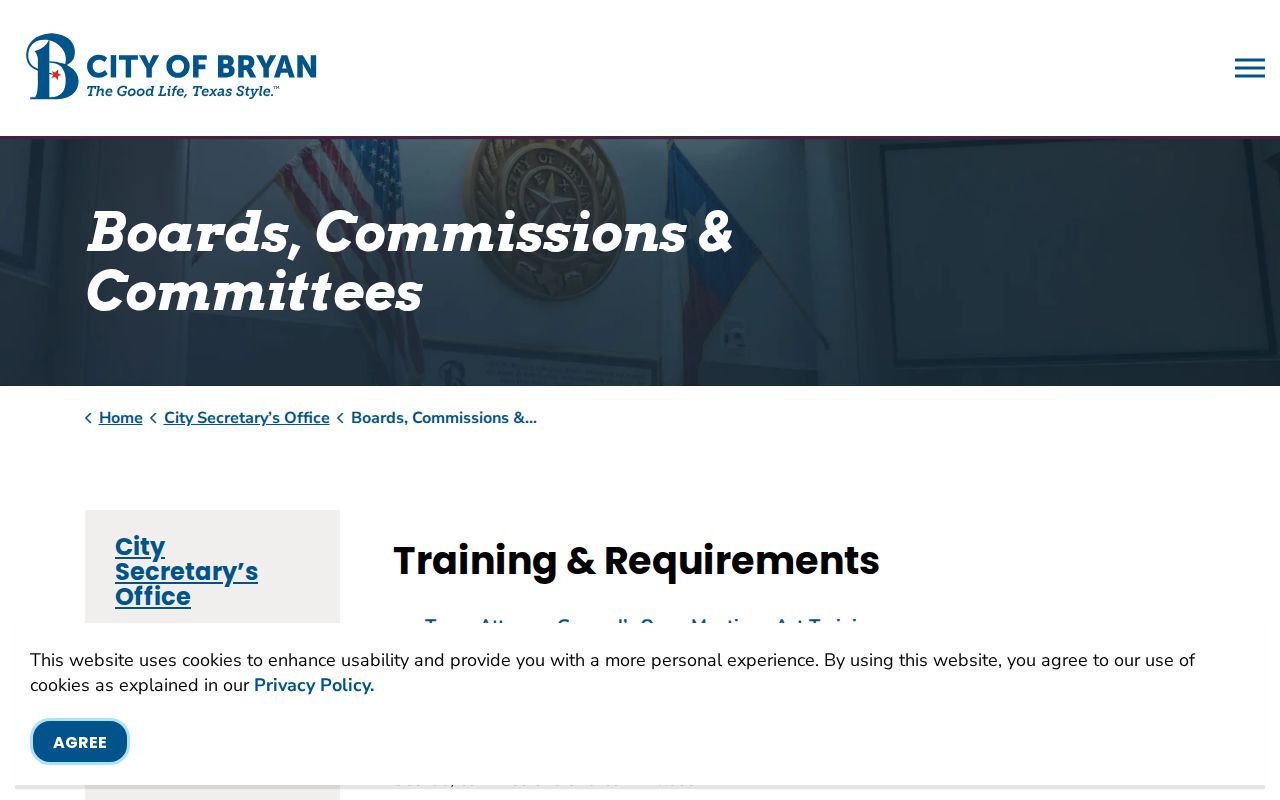
Civic membership is an identity anchor for that public role, not a substitute for a current household record.
Bryan Court Names Need Context
A court index can be a valuable source for family-history, probate, or a defined case question, yet a name match alone says very little. The Brazos District Clerk is the custodian for felony criminal, misdemeanor, family, juvenile, tax, and civil matters at the county level. Its Judicial Records Search link leads to the Tyler portal, but the research inspection could not verify live fields, image access, account requirements, or coverage. Treat that landing page as a route, not as a promise that every file is online.
The District Clerk request form gives a reliable fallback. It asks for the searched person's full name, a record date within five years, alternate names, case number, record type, delivery method, and other request details. It says criminal and civil searches generally cover 1992 to present, with a $5 search fee, $1 per page, and $5 per certified document. Historic Kofile books have separate series and controls. A case name must be checked against its number, role, docket, and disposition before it is treated as an identity match.
City of Bryan open-records requests shows the city route for material created or received by a Bryan department.
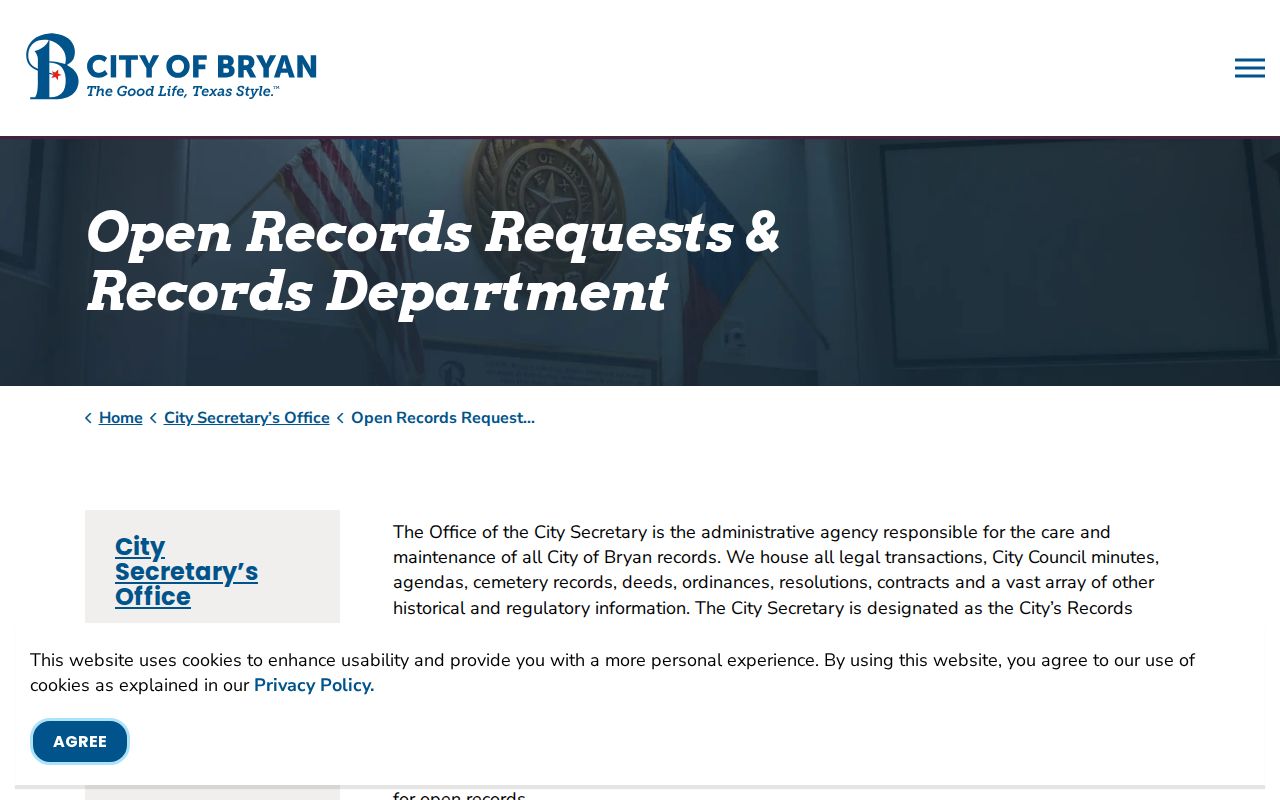
City-created material goes through the City Secretary route unless a department identifies its own custodian.
Bryan Vital Record Custody Split
For a Bryan birth or death question, event location matters. The research found that births and deaths inside Bryan or College Station city limits from January 1, 2019 are directed to the city registrar. The Bryan City Secretary receives and issues birth and death certificates, amendments, name changes, court-ordered adoptions, and burial-transit permits. The Brazos County Clerk maintains county-held certificates and marriages, while Texas DSHS provides statewide indexes and verification routes.
Texas Government Code §552.115 makes a birth record public on its 75th anniversary and a death record public on its 25th anniversary, subject to the special unidentified-death rule. Current certificates require eligibility and identification. A DSHS index is a finding aid, not a certified record or proof of parentage. DSHS digital birth indexes begin in 1925 and death indexes in 1965, with some earlier microfiche available from 1903.
The Bryan City Secretary is the city-level records-management and vital-statistics route for this residents directory.
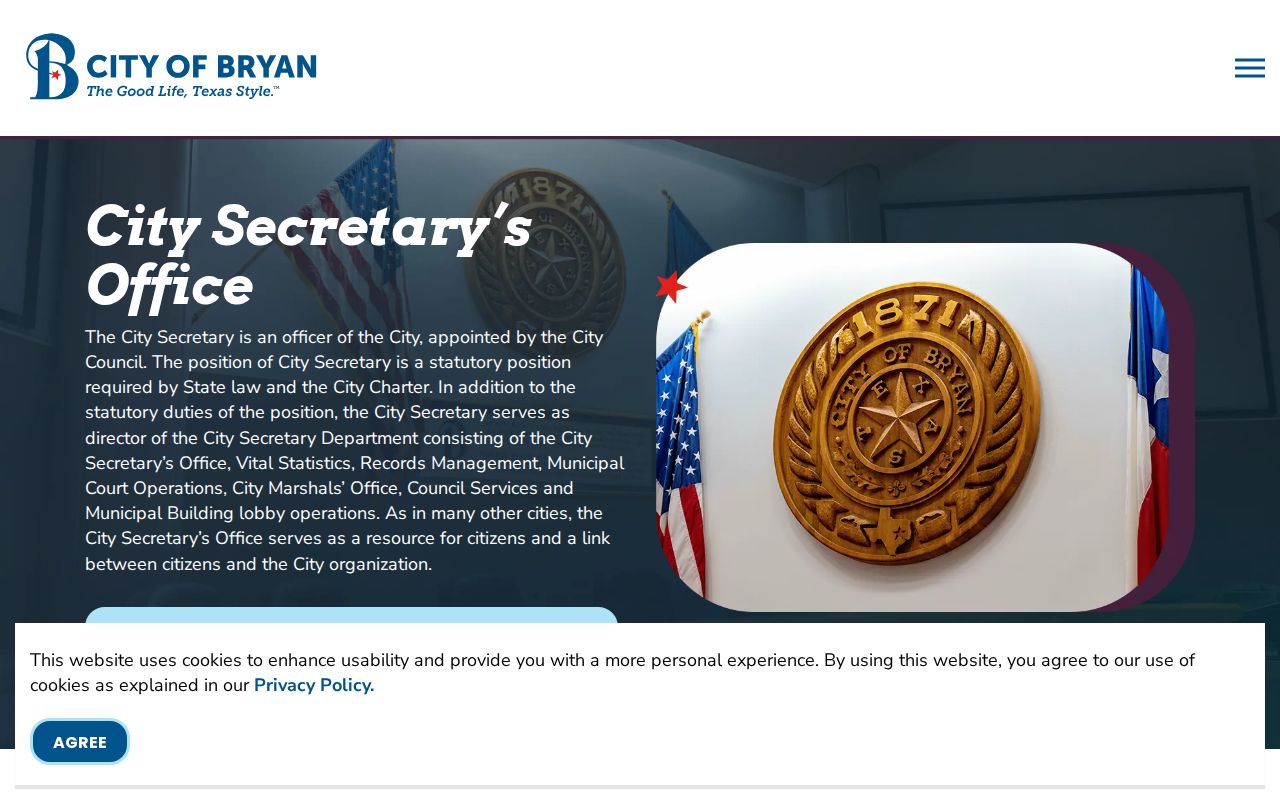
Separating the local registrar from the county and state routes avoids sending an eligible request to the wrong custodian.
Texas DSHS request procedures set out the statewide application route and current access guidance.
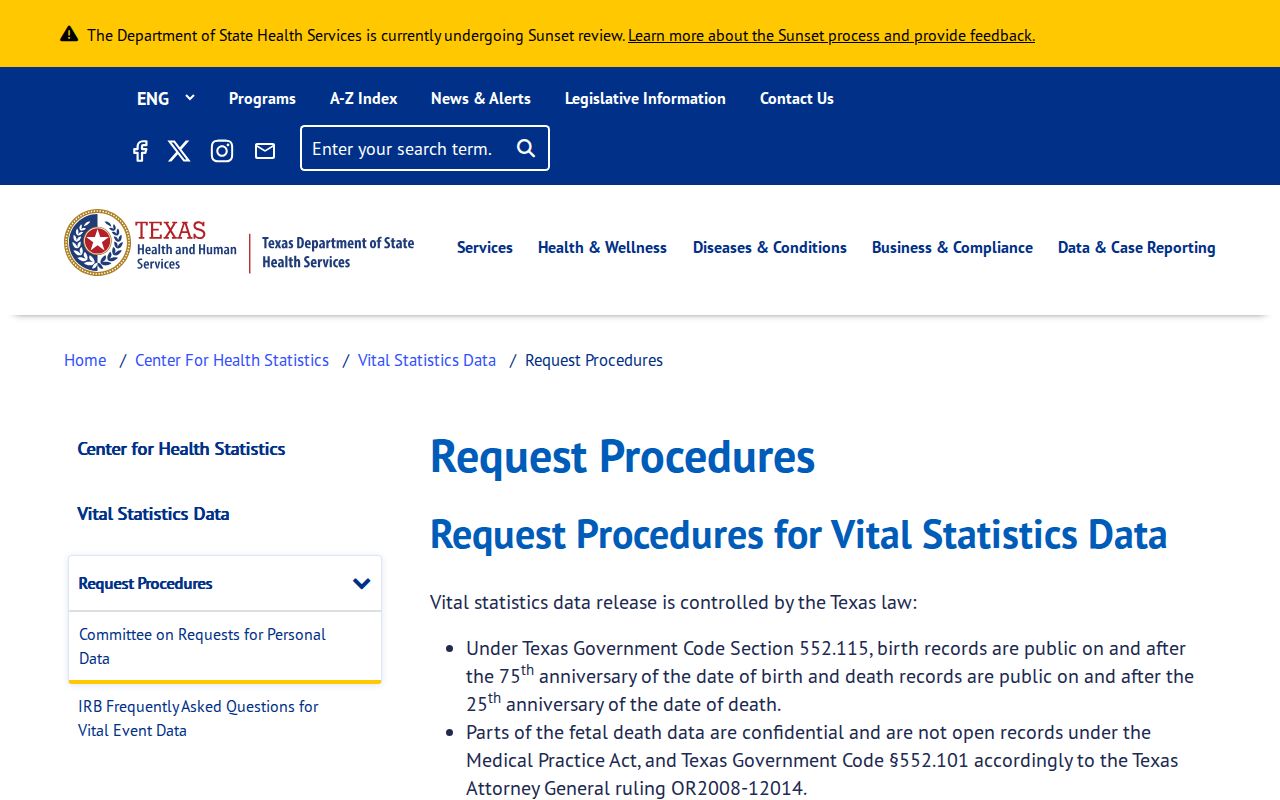
The displayed procedure should be checked again when ordering, because forms, fees, and processing notices can change.
Bryan Requests When Portals Stop
Public access does not always mean a complete online index. Brazos County says completed open-records requests can be made online, by mail, fax, email, or hand delivery. The request should describe the records, provide contact and delivery details, and name the date span, address, person, or identifier that keeps the search narrow. Most county requests are processed through the County Judge, except records created or received by elected officials. Those offices can have their own routes.
Texas Public Information Act requests work best when they ask for existing records rather than demand a new report. Under Texas Government Code chapter 552, the research notes a 10-working-day notice benchmark, estimates over $40, and possible prepayment over $100. A records request does not overcome a separate confidentiality law. Ask for inspection or redacted copies where appropriate, retain the response and any exception explanation, and do not mistake a withholding for proof that no record exists.
Bryan Archive Shelves and Microfilm
Past residents are best approached through dated local collections. The Carnegie History Center at 111 S Main holds local archives, artifacts, historical material, and a genealogy collection. Its public listing gives weekday hours of 10 a.m. to 5 p.m. and describes a special-collections and digitization connection. The building opened in 1903 from a $10,000 Carnegie grant and remains in its original library purpose, a locally distinctive reason that Bryan's historical shelf is still close to the old downtown records landscape.
Carnegie and Texas A&M hold surviving Bryan and College Station city-directory material back to 1937. Texas State Library and Archives Commission materials add reel-level Brazos County runs: deeds from 1841, deed indexes from 1841, marriages, probate, tax rolls, court minutes, naturalization, and other county series with noted volume gaps. Texas A&M Cushing Library is another discovery point, including partially processed Bryan City Records ledgers. Request access before a trip rather than assuming a title is digitized.
TSLAC's Brazos County microfilm inventory lists the reel-level runs that extend the Bryan historical record trail beyond a modern portal.
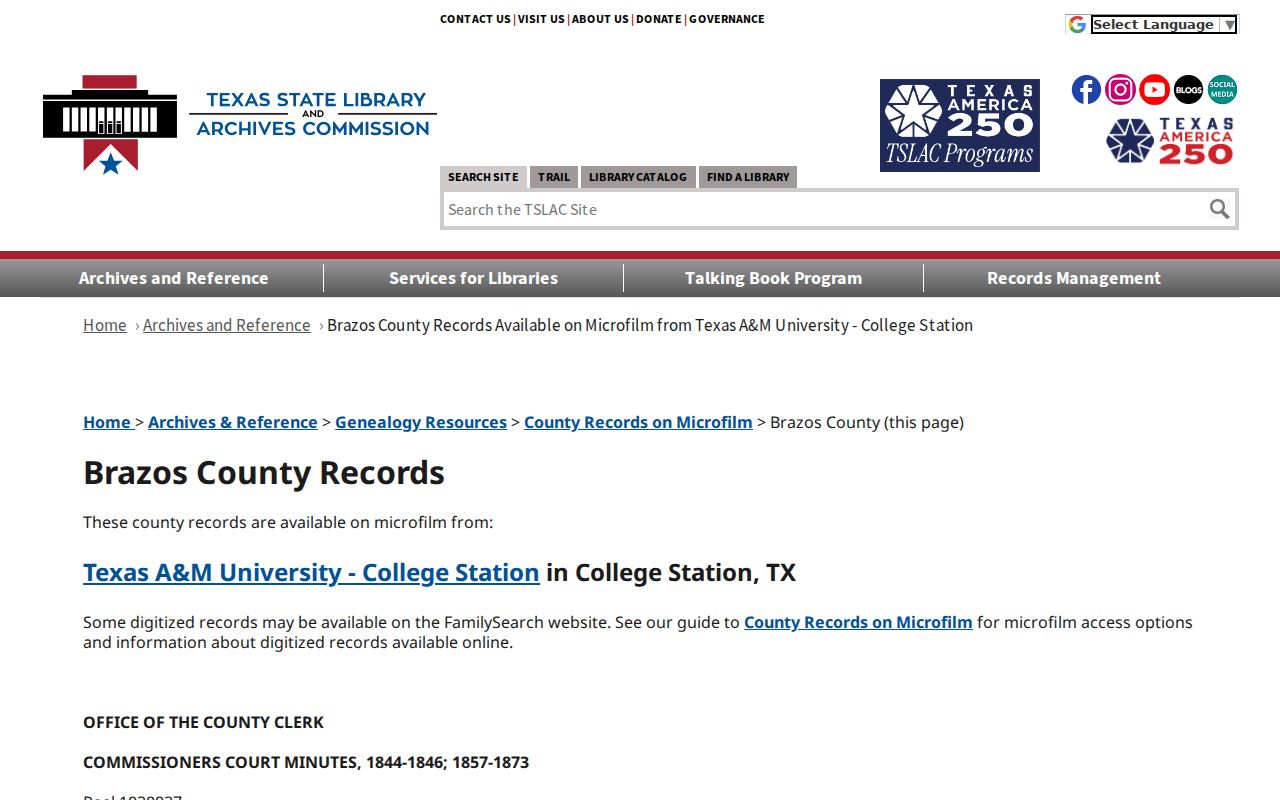
Reel, volume, page, filing date, and repository details make a historical find repeatable for the next check.
Historical Bryan Resident Directories
Historical city directories can tie a name to an address, occupation, telephone, spouse, or street section for one edition. They are time-stamped evidence, not a current address claim. Local Bryan and College Station directories survive back to 1937 at Carnegie and Texas A&M, while telephone-directory leads reach into the 1920s. The Texas State Library guide and UNT's digitized collection are useful discovery routes, but the research did not establish one complete Bryan publisher-by-year list or a confirmed complete reverse-directory run.
A criss-cross directory is an address-to-name format, if the repository confirms it has the needed edition. Pair a directory with an adjacent census year, deed date, newspaper notice, cemetery evidence, or probate file. The full historical-collection method belongs on the Bryan city directory page; this residents directory uses it as one carefully dated layer.
Bryan Records Keep Different Clocks
Brazos County history explains why Bryan searches may cross old and new custodians. The county was created in 1841, renamed Brazos in 1842, organized in 1843, and had an early seat at Boonville before Bryan became the county seat in 1866. Bryan was incorporated in 1871. A nineteenth-century record may use a place name, seat, street pattern, or repository rule that does not match a modern web form.
The time ranges are equally important: deeds begin in 1841, TSLAC lists historic court and probate reels, the District Clerk request form generally searches 1992 forward, and statewide vital indexes begin at different years. The Bryan 150 timeline offers date pegs such as the 1867 train and telegraph, 1868 cemetery, and 1883 A&M and Bryan telephone connection. These are search clues for a date range, not identity proof.
Census QuickFacts for Bryan supplies current city context, including a 2025 estimate that must be read with its stated vintage.
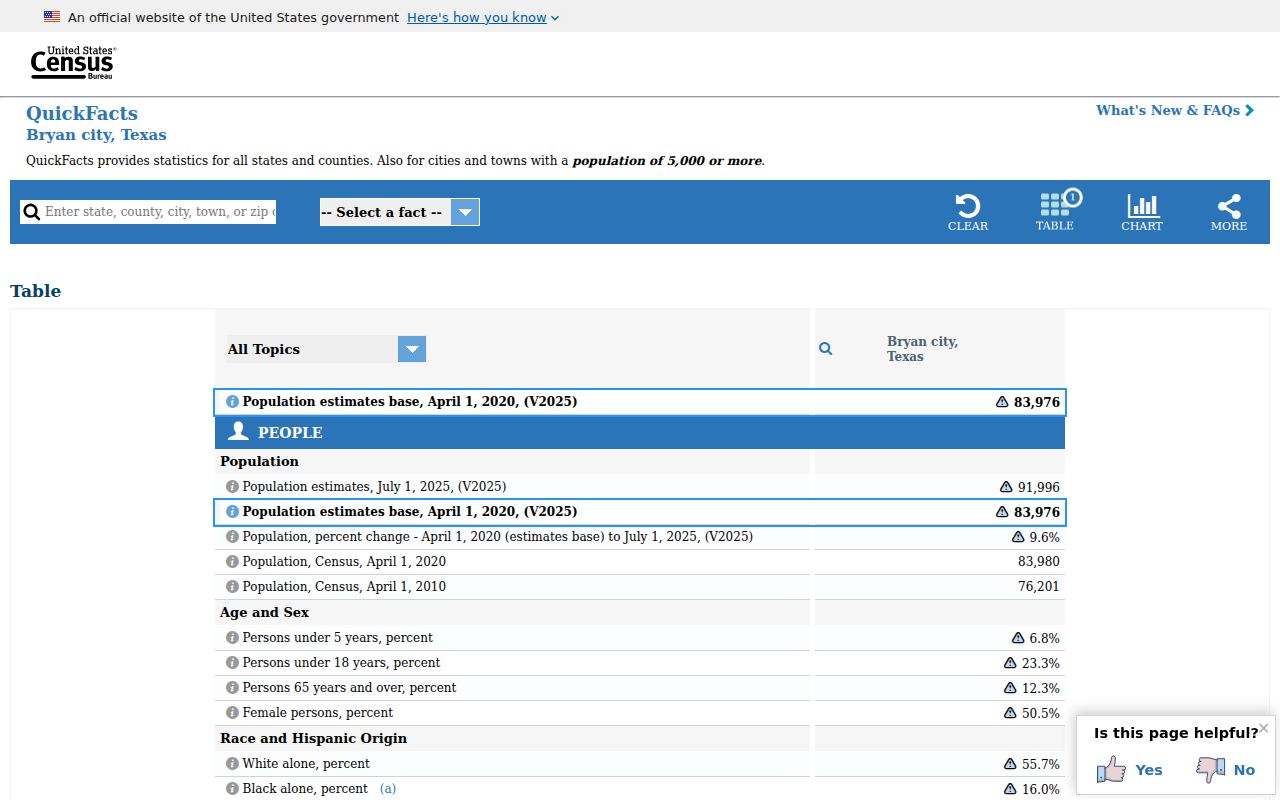
City population context describes Bryan as a whole and cannot verify a person, household, or address.
Bryan Resident Research and Privacy
Texas public-record rules include real limits. Address Confidentiality Program participants can use substitute addresses, and protected voters may have suppressed fields. Birth and death records have confidentiality periods. Juvenile, adoption, sealed, expunged, family, victim, and protected-address court material can be restricted even when a case index is visible. A public source should be used for the small, lawful question it answers, not combined into a broad profile.
Keep the source URL, access date, record identifier, and wording of any limitation. If a search does not find a record, say only that it was not found in the source and coverage checked. Portals change, names vary, and some material is indexed only on microfilm or at a counter. That recordkeeping habit protects people from mistaken matches and makes a later verification possible.